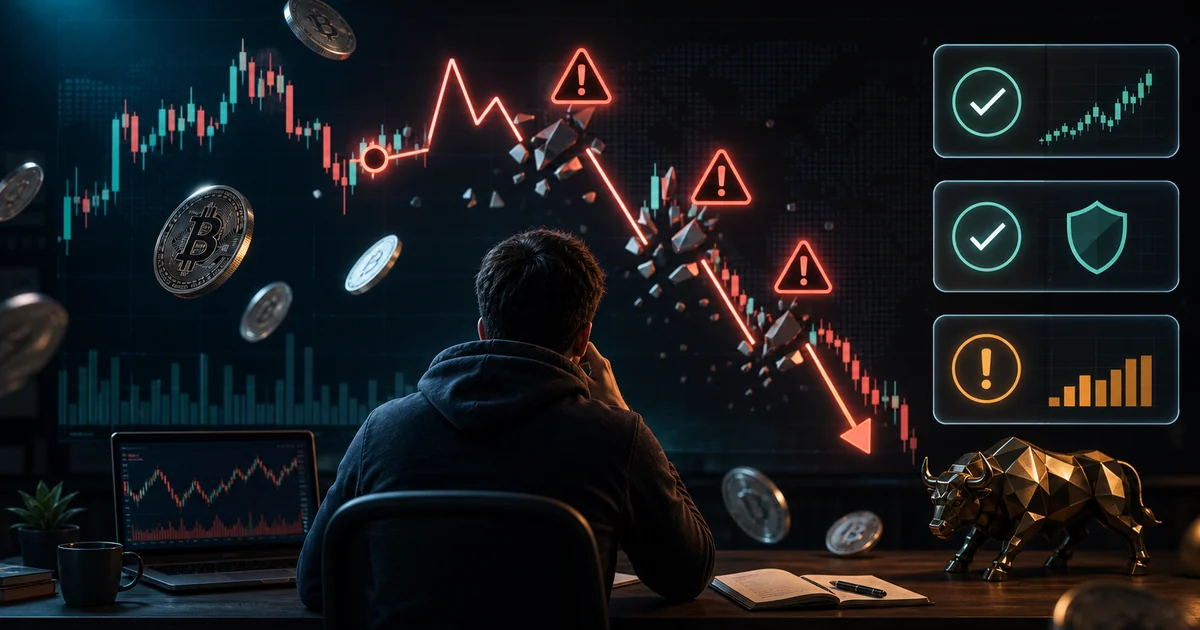
Crypto traders fail in remarkably consistent ways. Talk to anyone who's been in the market more than three years and they'll describe the same arc: a string of small profits that builds confidence, one terrible decision that erases all of it, then either quitting or starting over more carefully. The patterns are so repeatable that "beginner mistakes" is almost a misnomer - many experienced traders make these too, especially when emotion takes over.
What follows are the five most expensive patterns we see. Each is broken into why it happens, what it actually costs, and the specific discipline that prevents it. Read it, copy the fixes, and you'll dodge what wipes out most accounts in the first year.
No position sizing - going all-in on one idea
The single most common way new traders lose meaningful money: they see a setup they're sure about, and they put 80% (or 100%) of their portfolio into it. When they're right, the gain feels life-changing. When they're wrong - and you're wrong more often than you think - the loss takes years to recover from.
Why it happens: Conviction feels like information. When you believe in a trade, the discomfort of "missing out" if it works without you is more painful than the abstract risk of losing. The brain prefers the wrong concrete outcome over the right vague one.
The real cost: A 50% loss requires a 100% gain to break even. A 75% loss requires a 300% gain. Most blown-up accounts never recover not because the trader can't trade, but because the math after the loss is mathematically brutal.
Set a maximum per-trade risk before you open the position. A common framework: never risk more than 1-2% of your total portfolio on a single trade. That means if you have $10,000 and your stop-loss is at -5%, your position size is $2,000-$4,000, not $10,000. Boring? Yes. Survives 10 losses in a row? Also yes.
Trading without a stop-loss
Closely related to mistake #1, but worth its own section because it shows up even in well-sized trades. A beginner enters a position with a vague plan: "I'll get out if it drops a lot." There's no number written down, no order placed. Then the drop comes, hope replaces logic, and they ride it down 40%.
Why it happens: Setting a stop-loss feels like planning to be wrong. People resist it because it makes the possibility of a loss real. There's a magical-thinking comfort in "I'll just sell if it gets bad" without defining what "bad" means.
The real cost: Losses without stops compound emotionally as well as financially. By the time you've ridden one to -30%, you're psychologically unable to sell - you're now hoping for breakeven instead of cutting at a defined level. That's how -30% becomes -70%.
Decide your invalidation level before you enter the trade. Where is the price level that would prove your thesis wrong? That's your stop. Place the actual order on the exchange - don't keep it in your head. If thinking about the stop level changes how you feel about the trade, the trade was too big.
Chasing pumps after they happen
A coin is up 40% on the day. Twitter is on fire. The chart is a vertical green candle. Everyone you follow is posting about it. You buy. Within 6 hours the price has rolled back over and you're sitting on a 15% loss on a position you took five minutes after the move ended.
Why it happens: Pure FOMO - fear of missing out. The brain interprets a fast-moving asset as urgent. Combined with social proof (everyone else seems to be in), it short-circuits the deliberate part of decision-making. You're not analyzing; you're reacting to a perceived deadline.
The real cost: By the time a pump is visible to everyone, the people who made the real money are already exiting. You're providing the liquidity for their profit-taking. This isn't speculation - it's how distribution literally works.
Use a simple rule: if the move is in the news, the move is over for you. The opportunity was hours before the headline. Tools like CryptoFlow's volume signals exist specifically to spot accumulation phases before the pump. After the candle, your edge is gone.
Revenge trading after a loss
You take a loss. It hurts. Something inside says, "I need to make that back, now." So you open another trade - usually bigger than your normal size, often in a direction you haven't analyzed carefully. It loses too. Now you're chasing two losses. By end of day, you've turned a manageable 3% drawdown into a 15% disaster.
Why it happens: Losses trigger a specific neurological response - a need to "make it right" that overrides rational planning. It's the same circuit gambling addiction runs on. You're not trading anymore; you're trying to undo a feeling.
The real cost: Most catastrophic account blow-ups don't come from one bad trade. They come from a chain of three or four revenge trades after one acceptable loss. The first loss is the cost of being in the market. The chain is what kills the account.
Hardcoded rule: after any significant loss, no new positions for at least 24 hours. Close the app. Take a walk. Sleep on it. If the setup is still good tomorrow, it'll still be good. If it isn't, you just avoided another mistake. Professional traders take "tilt time" off the desk for exactly this reason.
Leaving large balances on exchanges
This one isn't about trading skill at all - it's about not losing what you've earned. Mt. Gox, QuadrigaCX, FTX, Celsius, BlockFi - the list of major exchanges that have failed and taken user funds with them is long. "Not your keys, not your coins" isn't a slogan; it's documented history.
Why it happens: Convenience. Moving coins to self-custody requires learning about wallets, seed phrases, and being responsible for your own security. Keeping everything on the exchange is one tap easier.
The real cost: When an exchange fails, customer funds become an unsecured creditor claim in bankruptcy. FTX customers waited years for partial recoveries, and many got cents on the dollar - or nothing.
A simple split: keep only what you're actively trading on the exchange. Move the rest to self-custody. For most traders, that means a hardware wallet for long-term holdings, and a software wallet for medium-term. The exchange becomes a tool, not a bank.
The mindset shift that prevents all five
Look at the five mistakes again. They share a single root: treating trading as a way to feel something rather than a way to manage probabilities. Going all-in feels exciting. Skipping a stop feels optimistic. Chasing pumps feels like belonging. Revenge trading feels like control. Leaving funds on an exchange feels easy.
The traders who survive long enough to compound their gains have all made the same internal shift: they stopped trying to win every trade and started trying to lose acceptably on the ones they got wrong.
That shift is what risk management actually is. It's not about being conservative or pessimistic. It's about staying in the game long enough for your good decisions to matter. A trader with a 55% win rate and proper position sizing will beat a trader with a 70% win rate who blows up once per year - every time, over a long horizon.
Before your next trade, write down two numbers: your position size and your stop-loss price. Set the actual stop order on the exchange. If you can't do those two things calmly, don't take the trade. This single habit prevents most of what's in this article.
Final thought
Every experienced trader you respect has made every mistake on this list at some point. The difference between them and the people who quit isn't talent - it's that they recognized the patterns, wrote down rules to prevent them, and treated those rules as non-negotiable. The patterns repeat. The fixes work. You just have to actually use them.
If you want to go back to the analytical side of trading and learn the volume-based edge that this tool was built around, the first article in this series is a good restart.
Trade with better information
Volume signals don't fix discipline problems, but they do help you spot real setups instead of chasing pumps. Open the dashboard and start watching what's actually happening.
Open the Dashboard →